Monday, September 30, 2019

Friend to the Friendless: The Story of Dottie

Mom did not like to socialize in the normal sense.  She wasn't into church and all the fellowship that came with it.  She helped with the school rummage sale every year yet kept her distance from the other moms at St Vincents School.  I can remember only a few bingo parties that she and Dad held at our house when I was very young. She occasionally turned on the creepiness with the seances that she hosted at our house with her psychic friend, the Reverend Cecil Cawthorne, running the show.  The only neighbor she allowed into our house was lonely Grandma Balistreri, the old Italian lady who lived across the street. Mom didn't want people knowing our business. Mom's oldest sister Amy, who lived in Ephrata, Washington, was her best friend and only confidante, and they talked long distance on the phone fairly often. But even though she didn't have close friends, she was rarely alone on Eagle Street.

Most of Mom's interactions with people came through her weekly sales and purchases.  Most of those transactions were one time deals, and we never saw the person again.  There were a few people, however, who answered an ad and then kept coming back.  And Mom was okay with it.  Normally, the person would call to inquire about something Mom was selling, they would come to see it, and usually buy it.  And then they would keep coming over, for weeks, months, and even years.  Usually these people were on the fringes of society, either down on their luck, or strange and misunderstood.  Mom filled their need for someone to talk to.  Mom was like a neighborhood bartender.  She would offer someone a comfy chair, a bottle of pop, and a snack, and before long, that person would share their entire life story. Their stories were never ones of success. Over repeated visits, we would soon learn of their dreams, their conflicts, and their disasters. Mom was a very good listener, and made these folks feel welcome in our home.  She was a friend to the friendless. There were many people who drifted into and out of our lives on Eagle Street. One such person was a woman named Dottie.

In July of 1974, Dottie answered an ad and bought one of our silver Poodle puppies for $85.  She was 50ish and had red hair.  She said she was a dog groomer and had a shop in Logan Heights.  A few weeks after the purchase, her puppy's AKC registration paper arrived in the mail. Mom decided to drive down to her shop and deliver it in person.  When we got to the National Avenue address she had given us, what we found was a vacant storefront with a small hand written sign on the door that said "Dottie's Grooming."  It was on a gritty, sad street in the bad part of town, surrounded by similar dirty old buildings.

Mom parked the car and I got out to go take a closer look.  I looked through the grimy window.  There was just an empty dark space.  In the rear of the building, I saw a faint light.  Then I heard a dog bark, and saw our puppy running towards the window.  Dottie appeared from the back room and I waved to get her attention.  She unlocked all the latches and let us into the dim and empty space.  That was when we realized that she had no grooming shop.  She was living in the back of a dilapidated empty store, with just a dirty old toilet and sink.  She had a cooler to hold her food.  A suitcase of clothes and a blanket and pillow lay on the worn tile floor.  After getting over the initial shock, Mom invited her to come over for pizza that night. And that's how Dottie became a familiar face on Eagle Street for the next decade.

Over many visits to our house,  Dottie eventually shared that she had four failed marriages, with a child born from each husband. Her great love (and her biggest impediment to success) was Las Vegas. When she spoke of this mysterious place, her eyes sparkled, and she got very excited, the way we kids acted when we were begging mom to take us to Disneyland.  She admitted that her four divorces and four lost homes were due to her gambling addiction.  But she didn't seem to understand that she could change her life simply by staying away from Nevada. Her youngest daughter lived there and was a cocktail waitress at the Hilton Hotel and Casino, so there was always an excuse for Dottie to go back for a visit. She spoke of her oldest son and daughter, who sounded like responsible people and were living their own lives somewhere. I am sure they had tried to help their mom many times over the years.  Her youngest son Alan, who seemed like a really nice guy,  had just ended a relationship and joined up with his mom in the daily struggle to stay off the street.
Dottie and Alan handling some business in our cluttered Eagle Street living room sometime in the 80's. Alan was always pensive.  Dottie however, always remained positive that her big break was just around the corner.


As time passed,  Dottie and her son Alan bounced between Los Angeles and San Diego. They were always on the move, chasing some business scheme that never panned out. In San Diego they hopped around nearby neighborhoods of  North Park and City Heights, going from one rental to another, month after month. Back in those days, it was so easy to rent a place in San Diego. They could always come up with the first month's rent, but then things fell apart and they were hurriedly packing up their few belongings and moving on.  Eventually, Alan figured out he had one last chance to escape his situation. He was nearing the age deadline to join the military and at the last minute he signed up and was sent to Montana.  Alone again, Dottie scraped and hustled.  She rang the Salvation Army bell at Christmas and was able to skim enough change from the kettle to get by. She painted houses and did whatever she needed to do to earn some money.  She always remained cheerful, no matter how messy her life was. And no matter what, she always gravitated back to Las Vegas.

One summer day in either 1984 or 1985, Dottie called Mom to give her some exciting news.  After the conversation, Mom hung up and announced that Dottie had found her golden goose.  She had told Mom of her good fortune in meeting Ralph, an ancient man who was very hard of hearing and was almost 40 years older than she was. She met him on a sweltering hot day, while he was handing out religious tracts in front of a North Park grocery store. He was all wrapped up in a winter coat and wearing a woolen hat and muffler.  Dottie stopped to talk to him and discovered that he owned a little house on nearby Mississippi Street. She offered to go home with him, cook him a meal and do his laundry. That was an offer he couldn't refuse. She basically moved in with him the day they met.  Within weeks they were married and before you could blink,  the house was sold despite attempts by his worried adult daughter to stop him.

That was the last time we saw Dottie because the two newlyweds took the money and moved away to----yes, you guessed it---Las Vegas.  In July of 1986, one month before Mom passed away, she received one final call from Dottie, informing her of Ralph's death.  He was 100 years old.  Where Dottie ended up next is anyone's guess.  But she will always remain an Eagle Street memory.


Thursday, July 4, 2019

July 4th on Eagle Street

There are many ways people on Eagle Street celebrated Independence Day back in the 60's and 70's.  One family went sailing, others spent the day looking for a spare patch of sand at the beach. A few went on simple picnics at Presidio park.  There was the Del Mar Fair or Belmont Park for others who liked to visit crowded amusement parks. The general idea was to situate yourself early in a place where you could enjoy the fireworks later on that night. Mom wasn't into any of that kind of exhausting nonsense. We stayed home.

July 4th was usually a frustrating day for us kids, because all the other kids on the street were off having fun with their families and we had no one to play with. The worst part, however, was that we always wanted to see fireworks, but never could.  No amount of begging could get Mom to leave the house.  Our holiday was always spent at home, end of discussion. So this story is not about anything noteworthy. The reminders of Eagle Street July 4th celebrations are a bit subtle, but they still exist.

These things were always a part of our yearly celebration:
Swamp coolers
Swimming pools
Corn on the cob
Shasta soda pop
Watermelon
Temporary suspension of the Streetlight Rule
Road flares
Goodyear Blimp

July 4th was usually very hot. Someone in the family would have to go down to the scary basement to retrieve the huge old swamp coolers and then set them up in the front room windows for Mom. The wires were frayed, and the machines were old rust buckets.  But somehow, Mom and Dad were able to repair them enough to keep them going summer after summer. We had to keep the big machines filled with Mom's distilled water to keep them working properly.  They would blow damp, cool air into the front room where Mom sat watching TV.

We spent lots of time in the pool.  During most of the 60's, that meant splashing around in a little inflated kid's pool in the yard.  We enjoyed a huge upgrade in 1969 when the real pool was installed in our backyard.
By July 4, 1970 we were out of the kiddie pool and in the enclosed, 98 degree real pool. Jeff is on the slide and Tammy is climbing the ladder. We could swim like fish, but for the first year, Mom made us wear life vests and buoyancy belts.


Mom rarely cooked. But on July 4th she always served up corn on the cob.  It was the one day of the year that she would dig her metal pressure cooker out from the back of the cupboard.  That thing was terrifying. It made noise,  and Mom was always having to check the pressure gauge.  I didn't want to be in the kitchen with it because I was always afraid it would blow up. But it made really tasty cooked corn. I had no idea that there were other ways to cook it until I grew up and discovered a pot of boiling water works fine too.

Mom never strayed from her daily diet of Tab. But for us, she bought Shasta by the flat because it was really cheap. We returned to the fridge all day long to get our favorite flavors:  Black Cherry, Crème, Tiki Punch, and Root Beer.
An old newspaper ad from the late 60's. This was before we had aluminum cans. These cans imparted a slight metallic taste to the drink, and you could really screw up the pop top if you didn't pay attention while opening the can.


No Independence Day would be complete without watermelon.  This was before the personal size, the seedless and striped varieties hit our local grocery store.  Back in the day, watermelons were dark green, huge, and loaded with black seeds.  Mom loved watermelon. For herself, she would remove the rind and seeds, cut the watermelon up into small cubes, and eat it from a bowl.  For us kids, she would make huge half moon slices, rind and seeds intact, and make us go outside to eat it.

At sunset, when the street light came on, and the first star appeared in the sky, my little brother and sister and I would start hearing the first sounds of unseen fire crackers and fireworks. Mom would hand us our watermelon wedges and tell us to sit on the curb in front of our house.  Then she would go to the garage and get a road flare.
At 20 cents, a road flare, Mom's idea of Fireworks,  was bargain entertainment

She lit it and placed it in the street a few feet from where we were sitting. Normally, we were required to be in the house when the streetlight came on, or face swift punishment.  July 4th was the one and only day that this rule was suspended. We could sit outside to cool off in the dark and watch the flames without fear of the belt.

The road flare burned calmly in the street, as fireworks popped somewhere far away. We swatted away mosquitoes and competed with each other to see who could spit their watermelon seeds into the flame.  A road flare takes about an hour to burn out, but it kept our attention during that hour, because that was all the "fireworks" that we were going to get.  I watched it and daydreamed about all the places I would take my kids to when I grew up.  I had it all planned:  I would take them to the Fair, to the beach, to the park, and to any place where we could watch fireworks with everyone else in town.

As the road flare sputtered and began to die out, we heard the familiar low-pitched hum of the Goodyear blimp.  It flew overheard and its animated Super Skytacular show flashed colored lights that were fun to watch.  The blimp flew around and around our neighborhood.  Sometimes the lights created a waving American flag, sometimes the lights flashed stick figures, or hula dancers, or geometric patterns. We kids felt that the blimp brought the light show to Eagle Street just for us, since we were the only ones out on the street to see it.

After the flare died and the blimp drifted away, Mom came out to herd us inside.  Another July 4th in the books. Just like the year before, and just as the next year would be.  It was our simple way of celebrating the day on Eagle Street.


Sunday, June 23, 2019

Send in the Clowns

Cherub and Angel
We didn't start out as a clown family. There was one year when big brother Skippy donned a clown costume and became "Beepo the Clown" for my 6th birthday.
Tammy and BEEPO

But that was a one time thing. My little sister was absolutely terrified of clowns.  Ronald McDonald was not someone she ever wanted to meet, even if he was giving out free balloons. She would scream hysterically if a clown suddenly appeared at a Sears sidewalk sale or a business grand opening gala.

So it seems a bit strange that we all ended up being clowns years later. Here is how it all began:

Mom had recently come out on the other side of a very bad relationship that ended in 1975 and had not only had left her broken-hearted but also broke.  She spent a good part of 1976 crying, talking long distance to her sister, and taking up with a parade of paroled felons who swooped in looking for  any spoils that my step-father Paris Young may have left behind.  There was a small window of time when she was in between bad relationships, from June until August.  With no man to occupy her time, she was free to spread her wings a bit and try something different.

School let out for the summer. It was the Bicentennial and the whole country was excitedly planning  patriotic celebrations.  The Summer Olympics in Montreal Canada was getting ready to take over my attention. And Mom decided to sign up for Clown College.

San Diego State University offered a 3 unit course in clownology. It cost about $90, not including make-up and costume, and lasted a couple months.  I don't know how Mom discovered it or why she decided to go for it. Starting in June,  she drove to SDSU for evening clown classes for the whole summer.  She would come home very excited, telling me about what they learned in class.  There are many things one must have in order to become a proper clown.  Make-up, costumes, and props are the big three.  One must think up a proper name, and then design a costume which reflects that name.  Mom, who was given the name "Angel" by the swindling, good for nothing, felonious man who had abandoned her the previous December, decided to hang on to the moniker, not only in real life but also for her clown name.

Mom met many very nice people who were also studying clownology.  In July she hosted quite a few parties, where her clown classmates would converge on the scene and practice putting on make-up.  I was pulled into the group, where they practiced on me too.
I was the make-up guinea pig

I was 15 and had other things on my mind that didn't include hanging out with a bunch of older people who wanted to paint my face and teach me how to make balloon animals.  But I didn't have much choice in the matter. I got to know these folks and was impressed by the things they did in real life.  There were dentists, fire fighters, doctors, artists, and business majors. Their enthusiasm was endearing and contagious.  By the time the class graduated, I was a clown too.  And soon after I was pressed into clown service, my younger brother and sister were pulled into the life as well.

The clown students went on many field trips during the summer. We all went to the Ringling Brothers Barnum and Bailey circus, specifically to watch the clown acts. The students marched in parades. They visited nursing homes and mental wards. They hung out in Balboa Park. People loved the crazy group. It seemed like there was always someone wanting a clown for their event back in those days.
The class made front page news. Angel is under the giraffe head

Mom spent a lot of time and money on her costume.  After a few false starts, she ended up with a square dancing-style dress and added petticoats, wings, and a halo.  There were lots of rules to learn if one wanted to be a proper clown. Some of them I remember were:  No smoking or getting drunk.  All body parts must be covered, either with makeup, wigs, hats, gloves, or clothing.  No bare hands allowed. One must never copy another clown's facial make-up.  And they all had to take a pie to the face. That was part of the final exam.

The Graduation ceremony was held on campus.  I remember that Walt Disney Studios was there to film some of it.  They planned to use some footage in a future Mickey Mouse Club episode.
Graduation Day

Angel with her diploma. There were lots of film crews there

Angel and her classmates, and me

Tammy, Poco, and Angel

In the end, Mom really didn't enjoy clowning too much. She took a few jobs here and there, but we three kids always had to accompany her and do most of the work.
Getting ready to get in the Clown camper to go to a job.  Sadsam, Sunbeam, Angel, Cherub, and one of our tiny Poodles

An inner city street fair


Oktoberfest 1976. Making balloon animals for the kids


We eventually figured out our costumes, make-up, and names. 
SadSam and Cherub
I became Cherub, Jeff was SadSam, and Tabatha was Sunbeam.  I had learned from Poco (the dentist) how to juggle.  I learned from Dr. All-Thumbs (the doctor) how to make balloon animals.  I did not have a pump to blow up balloons.  Back in the day, you had to use your lungs. Jeff learned a few magic tricks, and Tabatha could ride the unicycle really well. I also brought Poodles with me to some events.  We had a tiny blue Honda Civic with an 8 track tape player.  Mom had a tape of calliope circus music, and she blasted the stereo on our way to the gigs.  Kids would come running out of their houses because they thought it was the ice cream truck! They would instead see a tiny car with four clowns waving at them.

Tabatha, Cherub, and SadSam with Nephew Darwin David, and Nieces Samya and Jennifer.  I may be smiling, but I also had a horrible toothache that day and later had to have a molar pulled out.  
Within a few months, Mom was pretty much burned out. She figured out the clowning was not really much fun at all.  Her costume was heavy, thick and hot. It was exhausting work. You had to be upbeat, flexible, and willing to put up with crazy, screaming kids. You also had to be able to work through illness and pain. By the summer of 1977, Angel the Clown had retired and was sending Cherub, SadSam, and Sunbeam out to do the entertaining.
SadSam, Sunbeam, Angel, and Cherub (and Poodle) with nieces Sara and Becky


During the summers of 1977, 1978 and 1979, we worked with Vernon the Old Fashioned Clown (a retired Ronald McDonald) to provide entertainment at huge company picnics. These affairs took place at a Western-style venue in El Cajon called The Big Oak Ranch.  El Cajon in the summertime is miserably hot.  It usually exceeds 100 degrees.  And Saturdays and Sundays found us out there in full costume, make-up and wigs, sweating until our costumes were soaked. I did a juggling act, then inflated balloons and twisted them into animal shapes as quickly as possible for long lines of kids. Sunbeam unicycled to disco dance music on the stage,  and SadSam pulled off rudimentary magic tricks.  Vernon usually handed out candy. We would spend five sweaty hours dealing with hundreds of wild and sometimes bratty kids, watching everyone feasting on BBQ and wishing we could be having fun instead of having to work the party. Then it would finally be over and Vernon would drive us back home and hand us a check to give Mom. We would then spend the next couple of hours scrubbing all our greasepaint off. It was not a fun way to spend summer weekends. We kids truly hated it.
I still have Angel's clown badge 

I learned alot about hard work during our three years of clowning.  You must be patient and you need  to have a good sense of humor. You must be able to work through the worst of days. If you have a cold or, as I often did, a toothache, too bad--the show must go on.  If you are depressed and sad, you must nevertheless act happy. As much as I disliked it at the time,  I appreciate what clowning taught me.  The Eagle Street Clown Crew existed a mere three years, but the work ethic lessons that clowning taught me has lasted for a lifetime.


Saturday, December 15, 2018

Tammy's Eagle Street Christmas Story

Late at night every Christmas Eve, I take time out of my busy life to visit Eagle Street. I do this to pay homage to the memories that I made there, and to feel closer to the spirits of my deceased parents.  I park my car a block away and get out.  I am alone. At 9 PM, the street is dark and quiet. I can see Christmas trees glowing in the windows of many of the homes.  I begin my yearly walk in the night, pausing briefly as I reach my old house, then I continue past the other houses north towards my friends childhood home. As I walk in the dark and cold solitude, my mind reaches deep and pulls out some happy memories.  This is a memory of what took place in December of 1971, when I was 11 years old.

I was one of the final three children who lived at 4071 Eagle Street.  By the time the late sixties and early seventies rolled around, the older ones were gone.  Our neighborhood seemed polarized and relations between neighbors were strained.  And although I never knew the origin of the animosity, it was obvious that my family was a big part of the problem.  You can usually judge a family by how many times the cops show up at the door. We cornered the market on police visits.

Mom hated our next door neighbors. She called the south side neighbor "The Witch."  The north side neighbor was simply "Old Lady Mroz." It was obvious that a major war had occurred in the decade prior to my addition to the family, and the smoldering radioactivity continued throughout my childhood. This Cold War periodically reignited into momentary blowups. Insults were thrown back and forth over the wooden fence that separated our properties.  Sometimes the Witch would call the police.  We kids were never allowed to venture south past her house. And Old Lady Mroz yelled at us if we rode our scooters and tricycles past her house. It made it difficult for us when we wanted to go play at our friends' house.  The Manzer family lived one block north, and that block didn't seem to have a witch or a grumpy old woman.  That block also didn't have us living there. 

Our neighborhood friends were only allowed to play with us outside.  They candidly told me that their parents did not want them inside my house.  The only exception was when I had my yearly birthday party.  I guess their folks figured there was safety in numbers at a strictly time-controlled event.
The neighbor kids were allowed to come inside for my birthday, but never any other time. That's me, holding all the cards.

The only neighbor that ever visited Mom was the elderly Italian woman who lived across the street, Mrs. Balistreri. We called her Grandma.  Every Christmas eve, she brought over a big bowl of spaghetti with homemade marinara sauce, and a new pair of PJs for us kids. During the rest of the year, Grandma Balistreri would come over and spend hours crying about her deceased beloved first husband and her recently deceased and despised second husband. No one else would talk to Mom, nor she to them.
Grandma Balistreri (R) (with Aunt Sadie) Her homemade Italian sauce was so much better than Spaghetti Ohs!

Mom didn't want me getting too friendly with the neighbors.  Any time she allowed me to play with the Manzer kids down the street, she admonished me to never answer any questions that their Dad might ask.  So whenever he did ask me where my brothers were, I knew to never reveal their status when they were on the run,  in juvenile hall or in mental lockup. I learned to be wary of adults and to make quiet observations while keeping my mouth shut. 

Christmastime on our block was no different than any other time. Mom and the next door neighbors did not take a holiday timeout from the hate. Being home full time for a couple of weeks,  I could really feel the tension. There was no peace between Mom and the neighbors, and there never would be.  It bothered me, but it was our reality.  So my younger siblings and I spent lots of time around the piano singing Christmas carols.  My favorite song was, "I heard the Bells on Christmas Day." This was based on an old poem written during the Civil War by Henry Wadsworth Longfellow:

"I heard the bells on Christmas Day, their old familiar carols play.
And wild and sweet, the words repeat of Peace of earth, Good Will, to men."

 The 2nd verse really hit home with me:
"And in despair I bowed my head. There is no peace on earth, I said.
For hate is strong, and mocks the song, of Peace on Earth, Good Will, to Men."

One year, I got a glimpse of something other than continued war between neighbors.

It was 1971.  Dad had passed away just 3 months before. Our family had been through a lot since his death, including all of us nearly being killed due to a "mysterious" gas leak in our house. We had recently returned from an extended stay at Mom's sister's house in Washington. Mom was still down in the dumps. Dad's empty chair was a constant reminder that something was missing. This dark and depressing feeling draped over the house and us.  

A few days before Christmas, I was down the street playing ball with some of the Manzer kids, when their dad came out of the house. I had been told over and over again to never answer any questions he might ask about our family situations.  Even though we never had interacted much, he walked over and asked me if I wanted to go Christmas caroling with their neighbors that night.  I had never caroled before, but I had heard of it and it sounded fun, so I ran home and asked Mom if I could go.  I must have caught her at a weak moment, because surprisingly, she said yes.

At 6 PM, the Manzers and I met up with the rest of the group at Margaret's house. Margaret lived on the far north side of Eagle Street.  She was a good-natured older lady who always wore a bunny mask on Halloween when she gave candy to us trick-or-treaters.  We gathered there, a mixed group of about 30, and I marveled at the joy and anticipation that seemed to emanate from everyone. There wasn't any yelling, insults, cussing, or threats of police visits!

We walked to Falcon and Goldfinch streets, stopping at about ten homes belonging to very elderly people. At the time they were known as shut-ins.  We sang all the songs that I had practiced on the piano, including my favorite Wadsworth song. We sang the first 2 verses, and then the 3rd verse,

"Then pealed the bells, both long and deep, God is not dead, nor does he sleep.
The wrong shall fail, the right prevail, with Peace on Earth, Good will, to men."

We moved through the cold, dark night as a group, spreading good cheer and bringing smiles to the faces of those people.   I liked that feeling.   And when we were finished we all went back to Margaret's warm house. There was burning wood crackling in the fireplace, the tree was glowing, and the dining room was all decked out for Christmas. Margaret's best friend had prepared a fantastic spread of cheeses, sugar cookies, fruitcake and candies, with steaming hot apple cider with cinnamon sticks for the kids and mulled red wine for the grown-ups. I had never seen such a feast. At that moment in my life, I understood the 3rd verse of my favorite carol. I realized that there were people who want to do the right things, and that peace and good will is possible on Eagle Street.

Mr. Manzer and those other adults gave me something that Christmas that I had never felt before.  I felt like my voice mattered.  I felt like I belonged.  I felt like I was doing something nice.  I wasn't being judged by what my family had done in the past.  For one night, I was not one of the troubled Warriner kids. I was a free and independent person who was chosen to be in a Christmas choir made up of Catholics and Protestants, young and old. It was one of my happiest days on Eagle Street.


Friday, August 31, 2018

Our Animal House

We always had animals in the house.  When Dad was alive, the permanent collection was limited to Fudder the Manx cat, Tiny and Collette, the dogs, and Topper, the blue parakeet.  Other cats and dogs came and went.  They were merely passing through.  Once Dad passed away, however, our collection of animals started increasing, to the point where we reached hoarder status.

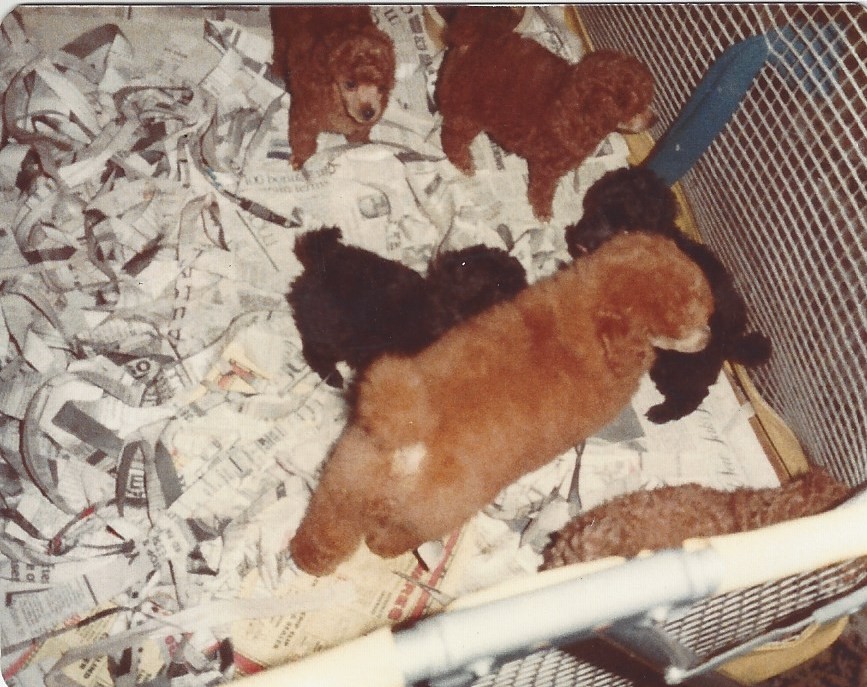
We started adding Poodles to the pack.  Mom supplemented our Social Security income with cash from the puppy sales.  Her first litters were silver Poodles, then through the seventies she branched out into chocolate, white, and apricot Poodles.
Tammy and the little kids with two summer litters in 1974


During the 80s, and right up until her death in 1986, she bred red poodles.  Mom dabbled a bit in exhibiting her puppies in local AKC dog matches.  A match is a practice dog show.  The ribbon winners didn't earn points towards championships, but it gave both handler and dog a chance to learn the ropes and prepare for actual dog shows.
Mom showing a dark chocolate poodle, 1977. She took 1st place.


In 1976, someone gave us a friendly little chicken named Sonya Henny.  She used to follow me when I walked the dogs down Eagle Street. She shared her day pen with a big white rabbit and a fluffy guinea pig.
Bambi the rabbit, Fluffy the Guinea Pig, and Sonya Henny, the chicken, 1976
I think these were called Dutch Dwarf rabbits, around 1978


There were also many more cats.  After Fudder passed away, someone dumped a pregnant feral chocolate Manx cat on our porch.  She had 6 kittens and we kept two of them, Fudder II and Mitty, our indoor cats.  We also ended up with about 4 outdoor cats.
Little sister loved the cats

Black and white Manx kitten.  The green skateboard was mine. Summer 1975 

In the 80s, Mom got into birds.  She bought an egg incubator and some eggs and started hatching and hand raising cockatiels. Her special hand raised bird was named Piper.
Mom's first one, hatched Sept 28, 1981. 
Here is Piper a few months later. He lived right next to Mom's chair in the living room
Mom also raised chickens in a playpen in the living room in 1981.
Mom got into hatching chicks in 1981.  The playpen was in the living room.


 For a short time she also kept tiny quails in an aquarium in the living room.
I don't know why she had these quails in 1984


Then she got a few pairs of parakeets and put nesting boxes in the huge free flight cages that lined one wall in the living room.  Soon, she had about 10 cockatiels and 50 parakeets.

Mom had four of these cages so the birds could stretch their wings
 I never knew there could be so many colors of parakeets until she started raising them.  The cute little babies were sold to the local bird store.
Some of the tame parakeets, 1984


The problem with the birds was that their bird seed attracted mice from the canyon.  The irresistible food supply resulted in the house being completely overrun.  The cats did their best to keep things under control, but realized they were so outnumbered and they gave up after awhile.

In 1986, Mom's final year of life, she had two huge cages full of parakeets in the back bedroom.  There were another two big cages in the living room.  These cages contained her cockatiels, a few parakeets, and rabbits. She also had four Toy Poodles. There was usually a playpen for puppies set up in the crowded living room.
This playpen always had some babies in it.

Her beloved dog Gigi was always at her side and went everywhere with her.  In retrospect, I realize that Gigi was the first emotional support dog I ever saw, before the term was even invented.
 She went with Mom to the bank and grocery store, sitting quietly on Mom's electric mobility scooter, and no one ever said a word about it.
Gigi slept on Mom's scooter so she would always be ready to go shopping

Mom's final animal project involved the rabbits.  One day she put her pregnant female rabbit in a pen on the front lawn, and the rabbit immediately dug a burrow under the tree in the yard.  The babies were born underground and we just left her there to raise them. Unfortunately, a couple days later she came up to the surface to eat and was attacked and carried off, either by a hawk or a coyote.  Mom, who was just two months away from her own demise due to congestive heart failure, did not have the ability to run outside when she heard the ruckus.  When I got off work the next morning and stopped over to check on her and to feed the animals, Mom told me what happened. I got a shovel from the garage and dug up the front yard until I found the orphaned rabbits.  One had died, but two were still alive and hungry.  Mom bottlefed those little babies until they were able to eat on their own.  The two little orphans went to a happy pet home.

Although she was very weak and dying, Mom raised those two babies

And here they are, healthy and ready to go to their pet home


When Mom passed away, all the animals, cages, and food were sold.  Soon, the only critters left in our Animal House on Eagle Street were the mice.


Friday, July 20, 2018

Skippy

Our family was a little ahead of its time I suppose.  Nowadays it isn't weird to have siblings who aren't entirely related to you.  There is no stigma involved in having different fathers for your various kids today.  But back then, the nuclear family of one mom, one dad, and a bunch of genetically related kids was the normal family. I saw many normal nuclear families at my Catholic elementary school.  Even as a small child, I liked seeing families where all the kids looked a bit like their mom and a bit like their dad.  Even the bad traits that seemed to be shared by whole families, like buck teeth and pigeon toes, seemed okay to me because they all shared a common characteristic, which to me meant order and belonging to a group. To me, the typical normal family seemed like a smooth blanket with uniform stitch work and a complimenting color scheme.  It was a nice, drawn-up plan with a pattern.

Our family, however, seemed like a rough patchwork quilt carelessly thrown together without a plan, with uneven squares, loose or absent stitching, and batting here, but not there.   And in spite of the obvious, we all had to pretend that it was perfect. Even before I knew anything about our family secrets, I was aware of this.  And I got weird nonverbal hits from outsiders, who didn't say anything out loud, but somehow I picked up on what they were thinking.

Truth eventually emerges, but usually not all at once.  For my first 10 years, the story of us was that there were 10 kids in the family and that we all had the same mother and father.

Then, I was told that the first 5 kids had their own father who killed himself when kid #5 was two months away from birth. Then Mom married our Dad, and they had kid #6, number #7 died at birth, and then miraculously, kids #8, 9, and 10 were born.

After that,  I was told that kid #9 had a different mother, and kid #10 was really my niece.

A few months later,  I learned that kid #9 was totally unrelated by blood, and that his adoption was botched and never finalized.

Finally, when I turned 18,  I was told that kid # 8 (which is me) was legally adopted and completely unrelated by blood to anyone in the family. (I was relieved to learn of this truth)

I think there is still more to our family story.  It has to do with kid # 5:  Rodney James Tompsett.

Rodney was never known by his first or his middle name.  Since he was a toddler, he was always called "Skippy." He was born May 22, 1949.  He joined a family with 4 older siblings, whose mother had become a widow less than two months earlier when her first husband "Bill" Tompsett committed suicide in his car.

Skippy was a cute little blonde haired, blue-eyed boy. Mom told me that he had suffered a botched circumcision, and that is why she did not believe in the procedure. By Lynda's accounts, older brother Tim was the favored boy who could do no wrong, while Skippy seemed to find trouble with every step. And when little Darwin came along 3 years later, it seems that Skippy became just another kid, stuck in the middle and not as important as either the oldest son or the baby of the family.

Mother's Day, maybe 1959 or 1960 from left:  Skippy, Mom, Darwin
Summer 1963 Skippy and Darwin with their balloon project

Skippy got a bunch of awards from camp that summer


Bepo entertaining my classmates and neighbor friends for my 6th birthday
My earliest memory of Skippy was when he dressed up as a creepy clown for my 6th birthday party in 1966. He was a tall lanky clown dressed in hobo pants, a cone hat, and a big wide tie emblazoned with his clown name "Bepo."
Tammy and Skippy (Bepo) 


I don't remember much about the party, but I do remember having familiar flashbacks to that day while watching "Homie D. Clown" on the comedy show "In Living Color" for the first time in 1990. Get on YouTube.com some time and watch the first Homie D Clown video. That skit is strangely similar to my 6th birthday with Bepo the Clown. At the time of my party, Skippy was almost 18 years old.  He had never spent much time with us during my youngest years. And he disappeared again not long after he clowned at my party.

Skippy was one of the problem boys in the family.  Mom and Dad never talked about him except when they were having to deal with his being in trouble. Sometimes there would be a late night phone call from Skippy asking to be picked up or bailed out. They were having to go downtown to either wire him some money or pick him up from the Greyhound Bus station. He was constantly outrunning the cops, who would often show up at our house looking for him. It was always something with Skippy.

Mom used to coach me on how to answer questions about Skippy if nosy neighbors were to ask me about him.  I was not supposed to tell them when he was being held in the mental hospital for acting crazy.  I couldn't tell them when he was in jail for various theft and burglary offenses. I was only allowed to say he wasn't home and nothing else.

I am certain that Lynda has some normal memories about Skippy.  But I don't,  because he started taking drugs in the 60s, and he never outgrew it.  He started with marijuana and alcohol.  Then he took uppers that made him act crazy.  Then he took stuff that made him see things that weren't there. Then he got into downers, and finally, heroin. He went to prison many times for stealing everything that wasn't bolted down.

He hung out with like-minded people-- strung out druggies, thieves and prostitutes.

One time he brought home a skeletal white-haired prostitute with only 1 front tooth.  She asked to use the bathroom, then came out scratching her crotch and complaining that the cream didn't kill all the lice.  Mom blew up and kicked them out of the house, then she grabbed a bottle of bleach and splashed it all over the toilet seat and the floor of the bathroom and had me wipe it all up.

Another time he brought over an old whore who had just been released from what we called Patton Insane Asylum. She had killed her baby and was found not guilty by reason of insanity.  She had a weird taste for Arby's Horsey sauce.  We had several packets of it in the kitchen, and she asked for a glass of milk, then started squeezing the horseradish cream into the milk. And then she stirred it up and drank it down.

It isn't that the state of California didn't try to help Skippy. He was sent to rehabilitation therapy.  He was given occupational rehabilitation again and again.  He received grants to go to Mesa Community College. The taxpayers must have wasted hundreds of thousands of dollars on him, and none of the efforts to give him a chance for success did any good.  He couldn't stay out of trouble long enough to give  law-abiding living a chance to take hold.  It appeared to me that he was living his dream: drifting, partying,  and committing crimes of opportunity. It also seemed to me that as much as mom complained about his thieving ways, sometimes she took advantage of it.

One example occurred when he was in between prison stays.  Aunt Louise, an in-law of Mom's sister Amy,  passed away in July 1972.  She was a rich lonely widow and was going into the ground in style.  Mom drove Skippy and me to the Lewis Colonial Mortuary on El Cajon Blvd to visit the body.  Mom waited in the car.  Skippy and I went inside and the somber funeral director showed us to the darkened viewing room.  The room reeked of the huge rose sprays that decorated the room. Aunt Louise was in a dark wood casket with ornate carvings on the outside, and soft cream-colored velvety bedding on the inside. She was all decked out in a fancy green dress, with her hands folded across her chest. All her familiar rings were still on her fingers-huge diamonds, emeralds, and rubies.

Skippy wanted those rings, and told me she wouldn't miss them where she was going.  He said he wanted to get in the casket with her and take off all her jewelry. He approached the body and reached out to her hand.  I normally didn't say much to him but I was horrified and this time I spoke up. I told him quite forcefully that if he took anything off of her I would run to tell the man at the front desk.  I must have sounded serious, because he stopped, looked at me for a second, and then backed away, saying, "Well, lets go then, there is no reason to stick around." I had the feeling that stealing her jewelry was the only reason Mom drove us there.

He and his stinky runny-nosed hippie friends sometimes would rent a truck and drive it to a department store to do a little shopping.  But when Skippy shopped, he never paid for anything. One time, he backed a truck up to the loading dock of the Montgomery Wards, which used to be in Mission Valley shopping center.  There were cases of electric typewriters just sitting there, and he loaded them all into the truck and pulled away.  He then came to Eagle Street to drop off his load. Mom gave him money for the goods, and I got an electric typewriter for my birthday that year.

Skippy could never be trusted alone in a room, because he would steal whatever he could get his hands on. He stole pennies from my purse.  He stole the framed first dollar bill that little brother Jeff earned.   His crimes were sometimes petty and needless.

For example, I was scheduled to play some music on the pipe organ for a Christmas recital at my high school's convent chapel one year.  Mom didn't feel like going, so she sent Skippy in her place.  While I was performing, he just couldn't resist stealing my teacher's Bible that had been given to her by her parents went she entered the convent.  I didn't find out he did it until after we got back to school from Christmas break and the teacher was asking the students if anyone had seen it. I just knew he had done it, and found it later in his backpack of belongings that he left at the house.  He had cut out all the pages where her parents had written their dedications to her.  I didn't have the heart to return it with so many pages mutilated.  So I did nothing and just felt guilty every time I saw that poor old nun.

Skippy didn't have any impulse control or conscience.  He couldn't hold any kind of legitimate job.  He never had a real address because he never paid his rent, even when apartments were cheap and plentiful in San Diego.  Drugs were the most important thing in his life, and that is where any money he had went to.

He was the one who introduced Mom to Paris Young, her horrible third husband.  And after he got out of prison for the final time, he spent his days stealing, selling his infectious blood plasma,  buying drugs, Camel nonfilter cigarettes, and bottles of Thunderbird.  His teeth rotted out, his tattooed body was covered with sores from injecting heroin, his eyes were bloodshot, and he had a dirty Fu Manchu moustache. He was balding prematurely, and his remaining hair was filthy and straggly. He looked so bad that Mom joked that he looked like the Creature from the Black Lagoon.

One rainy night in January, 1978, Skippy got drunk and decided to take a walk on Interstate 5 near Old Town, and not surprisingly he was hit by a car.  The collision broke his legs in a few places and put him in the trauma unit at County Hospital in Hillcrest.  His social worker encouraged him to file a lawsuit against the poor Doctor who never expected a drunk zombie would suddenly stagger out on the highway in the dark and in pouring rain. He won a structured settlement and every month, he received a check that would have supported him.  But instead, he bought heroin and Thunderbird and lived on the street.

Skippy was not a son to be proud of.  Mom didn't want anyone to know he was her child, and she never wanted him to show up and have to be introduced or explained to new friends and associates. No one in the family who knew Skippy really wanted much to do with him because he was hopelessly lost.  So it was very odd that Christmas season of 1979, Mom was trying to locate him and bring him to Eagle Street.  She was getting a visit from someone she had never spoken of before, a man named Pete Arnett.  She was all excited about the visit and told me that Pete was an old friend from way back in the 40s when she lived in Detroit.  She told me that he still lived with his mother and that he had a big fat sister who was a bitch and was always trying to boss him around and get in his business.  When I asked why she wanted Skippy to come over when Pete was here, she changed the subject.
Pete Arnett and Mom, December 1979. Mom was very affectionate to him when he visited


 Pete arrived and stayed for a few days, and he and Mom seemed to be very familiar with each other.  Pete didn't care about touching base with Lynda, Tim, or Darwin, but he seemed to be interested that Skippy was going to come by. And then Skippy arrived and the three of them visited, with Skippy acting calm and well-behaved, which seemed very weird to me. It was like he was trying to give a good impression.  My instincts at that time were telling me that this man, Pete Arnett, was Skippy's real father. This is just my opinion.  But I would put money on a DNA test proving it. After Pete Arnett went back to wherever he lived, I asked Mom if he was going to be her new boyfriend.  Her answer made me think she had hoped that they could rekindle some spark that first occurred 30 years prior, but she knew it was not to be.  Pete never came back again after that visit.  I think when he saw Skippy, he was pretty turned off, and he choose to once again abandon his son, as he did in 1949.

Another piece of evidence that Skippy was not the 5th and final child of Bill Tompsett is a will that was written by Bill Tompsett's mother in 1964, before all Skip's crimes, insanity, drugs and disappointment became a big part of who he was.  The will acknowledges the first 4 children, but does not even mention Rodney James Tompsett.  If Skippy was truly the final child of her son Bill Tompsett, essentially a gift from the grave,  she would have cherished him and acknowledged him in the will. But she didn't.  The absence of his name indicates that Grandma Tompsett knew Skippy was not her grandchild. And if she knew, Bill probably knew too, and that could have been what led him to kill himself.


In 1984, Skippy came around with a young woman named Marianne.  He said they were married.  There was a baby girl born in October of that year, and he thought he would impress Mom by naming her Angelica, after Mom's fake name Angel. Mom was only mildly impressed.  But she hoped that maybe this woman and baby would make him turn his life around. But they didn't.

I learned from observing Skippy's pathetic existence that it does not matter how many times people bail you out of jail, pay for your rehab and medical bills, train you and place you in a job, or find you an apartment,  And it doesn't even matter if you find a person who loves you and has your child. It's often nothing but a big waste of time, trouble, and money. Because some people cannot be saved from themselves.  Skippy was one of those people who doomed himself to an early death.

On April 14, 1986, Mom got one last call from the authorities about Skippy.  His dead body had been found downtown, leaning up against a San Diego Gas and Electric building, dead from an overdose of black tar heroin.  The Coroner's office asked Mom if she wanted to come down and positively identify the body, and claim it for disposal. She said not unless she had to.  They told her it was not necessary, because his prints and tattoos were good enough. For the final time, the county taxpayers had to foot the bill to take care of the mess Skippy left behind.

Was Skippy just a "bad seed," as Mom often called him? Was he a victim of so much abuse in the home that he turned to drugs and crime as a coping mechanism? Was he truly mentally ill? Did his bad circumcision permanently affect his psyche?  Was he Bill's son, or was he Pete's son?  How many unsuspecting people caught hepatitis from the blood and plasma that he sold for drug money? How many crime victims are still out there wondering what happened to their class rings, watches  and family heirlooms that were stolen out of their homes?  There are many questions about him that will never be answered.  For me, Skippy was a huge life lesson, a cautionary tale, the reason I never experimented with drugs. He is why when I look at the hundreds of filthy, crazy, drunk and high feral people polluting the streets, shooting up, stealing bikes, and setting fires in the canyons,  I know that every single one of them had many chances to recover and reform but made their choice to wallow in misery.   Just like Skippy.


Saturday, July 14, 2018

Tiny

There were dozens of dogs who lived with us on Eagle Street over the decades. The alpha dog, and the one who was with us the longest, was a little mutt named Tiny.

Mom had recently suffered the loss of her stillborn son Jody Jim in March, 1959.  The traumatic event left her permanently damaged, both physically and emotionally.  She was no longer able to get pregnant due to the birth injury.  She was likely very hormonal and down in the dumps.  As we all know, there is nothing as therapeutic as a new puppy.  Right around the same time the Warriners were mourning the death of what appeared to be their final child, a litter of puppies was born somewhere in San Diego. Six weeks later,  Mom and Lynda went to take a look at them, and couldn't resist bringing one puppy home. 


Tiny was a small dog.  Mostly white, with tan ears and a round tan spot on the base of her spine, she stood about 13" tall and had a plumed tail that curled up over her back.  Mom said she was a mix of many things, but mostly Poodle, Spitz, and "toy Collie."

Lynda and Puppy Tiny play Tug-o-war on Eagle Street


Tiny was a very smart dog.  She was housebroken within a week.  She would go to the front door and sit down, and that's how you knew she needed to go out.  She never needed a leash, either.  You just let her out, she would do her business, and come right back inside.  Tiny was patient with children and loved everyone in the family.

Tiny is right there welcoming Grand Baby Cathy into the family in early 1960

Tammy and Tiny in the wagon pulled by Darwin, 1963

Tiny and Collette taking a bike ride with Tammy, 1970


Mom believed that everyone living in the house needed to somehow earn their keep.  That included the pets.   Tiny was definitely a mongrel, and there was no way she could be mistaken for any of the purebreds that made up her genetic pedigree.  But Mom soon discovered that if Tiny was bred to a purebred, the resulting puppies would more often than not look just like their sire.

Mom bred Tiny to a silver Toy Poodle from championship bloodlines.  The resulting litter consisted of 3 curly-coated black puppies that started turning silver as their fur grew longer, and one rare pup that was born silver, which almost never happens with purebred Poodles.  These puppies grew into beautiful Poodle-type puppies and they sold out immediately.
Happy customer Sophie with Herkimer, a rare born-silver Poodle pup from Tiny


A breeding to a long-haired cream-colored Lhasa Apso resulted in shaggy Lhasa lookalikes.
Tiny's first litter from a Lhasa Apso father


Here they are at 6 weeks with Darwin

When bred to a tan Chihuahua, the puppies were tiny, shorthaired and tan, with round heads and short muzzles, just like their sire.

Chance encounter on a city street with Pedro and 63 days later, Chihuahua puppies!


After the despised next door neighbor's dachshund, Hansel, paid a clandestine visit, Tiny gave birth to two dark brown puppies with long bodies, short legs, and floppy ears. And even though the neighbor huffed and puffed that her Hansel would never even cast a glance at our dog, there was no denying that the little Doxie lookalikes were indeed Hansel's pups. Mom hated Hansel's owner so much that she didn't take a photo of the two Dachshund puppies before selling them.


Tiny's final litter was a single surprise puppy, born long after a dog is ever expected to be able to reproduce.  We never knew who this puppy's father was, but because he had the same coloring as a St. Bernard, Mom advertised him as a "Toy St Bernard," and we could have sold dozens of them.

Nopey was Tiny's final puppy, born in 1970.  We wanted to keep him, but Dad said no.


Tiny had a false pregnancy one year, which enabled her to raise an orphaned Manx kitten which turned out to be our family cat Fudder.
Tiny and her kitten Fudder, 1963

Tiny loved other animal babies too.  She tried to help Collette with her big litter of six, but it was Fudder who ended up raising the two runts from that litter.

Right after this was snapped, Fudder came to the bed and took the tiniest puppy.
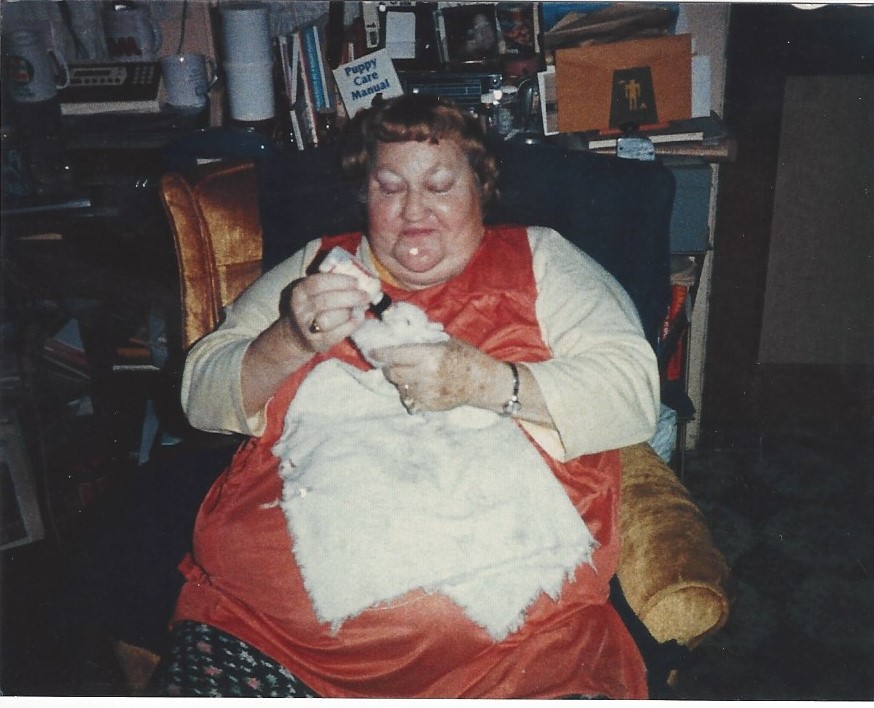

Tiny really loved Dad.  When he was relaxing in his La-Z-Boy with a drink and his pipe, Tiny was usually right there with him.

The usual scene when Dad got home from work, this was in 1971, Dad's final year of life.


In 1969, Mom came home with a mother and daughter silver Poodle duo, Tiny was not amused at all.  She had no problem accepting the calm and submissive daughter, Collette.  But with the mother Poodle, Musette, it was an entirely different story.  Both dogs hated each other and would fight whenever they were in the same room.

 Mom consulted Tiny's veterinarian, who suggested muzzling them and letting them work it out without being able to bite each other.  He hoped that they would eventually make peace with each other.  The two dogs were muzzled and the fighting began.  The dogs sparred until they were drooling and gasping, but they would not stop trying to kill each other. 

Tiny hated Musette, and after this failed attempt, Musette went to a new home

The vet's idea was a failure and Mom quickly found another home for Musette. After Dad died, and Mom started collecting dozens of Poodles, Tiny accepted every single one of them. 

Tiny, Collette, Gidget, Samson and Suzy with Tammy, 1971


When Mom bought an electric dog hair clipper and a grooming book, she experimented on Collette and even on poor Tiny, who did not need to be clipped, but got a Lion trim anyhow.
Tiny, Fudder and Collette with Jeff in 1969. Mom's first try at dog grooming. I didn't think Tiny's brown spot would ever grow back, but it did.


At Christmas time, Mom would hang little cocktail hotdogs on the bottom branches of our Christmas tree, then call Tiny and Collette over  so they could find their treats.
Once the gifts were opened, the dogs could find their treats on the tree.


Tiny came to Eagle Street during a time of great sorrow.  She cheered Mom up and nudged her out of her postpartum sadness.  She was a great watchdog.  She raised an orphaned kitten. She accepted everyone into the family except Musette.  Her puppies were a source of income.  She was there when the three youngest kids were introduced to the family.  She was also there when the ambulance came to take dad away after he died in his yellow chair early one morning.  

In 1974, Tiny suddenly suffered a stroke and couldn't walk.  Mom called Darwin and asked him to take Tiny to the vet to be put to sleep.  She lived 15 good years, had healthy hybrid vigor, and stayed perky until the very end. Tiny was one of a kind. She was the most beloved dog that ever lived with us on Eagle Street.